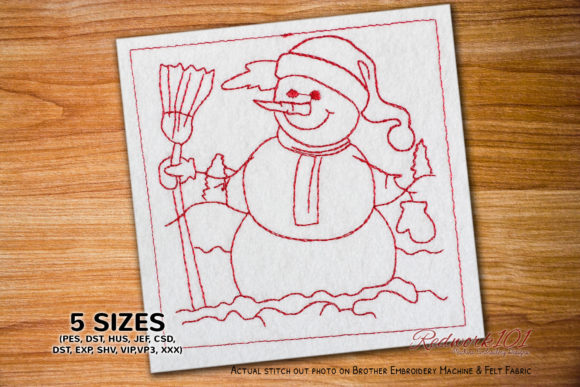
Christmas Snowman Bluework
A Thoughtful, Handmade Charm for Personalized Gifts
As an embroidery designer who’s stitched thousands of custom orders—from baby blankets to wedding keepsakes—I approached Christmas Snowman Bluework with both curiosity and high standards. Right away, its quiet charm stood out: a friendly snowman holding a broom, rendered in classic bluework style—clean lines, subtle texture, no clutter. It doesn’t shout “festive.” Instead, it whispers warmth, nostalgia, and gentle craftsmanship. This isn’t a cartoonish holiday graphic—it’s a handmade-feeling motif that invites slow stitching and slower gifting. Its mood is sweet but not saccharine, seasonal without being dated, and quietly elegant enough for heirloom pieces.
Where Christmas Snowman Bluework Shines on Real Products
This design excels where emotional resonance matters most. On a soft cotton baby blanket? Perfect—it reads as tender, timeless, and gender-neutral. Stitched onto a linen pillow cover for a nursery? It adds quiet joy without overwhelming the space. As a monogrammed kitchen towel? The snowman’s simplicity balances utility and personality—ideal for Etsy sellers offering curated holiday bundles. For wedding gifts, consider pairing Christmas Snowman Bluework with initials or a date on a cozy flannel throw—subtle, meaningful, and seasonally grounded.
It also works beautifully on aprons for bakers hosting holiday gatherings, tote bags for craft fairs (think “Handmade with Love, Stitched Just for You”), and even delicate muslin onesies—provided fabric and stabilizer are carefully matched. Small shop owners appreciate how easily it scales: same file, different placement, different story. A customer ordering a personalized gift for their first Christmas as parents? Christmas Snowman Bluework feels like a promise—not just of the season, but of care.
Smart Placement & Fabric Considerations
Not every surface welcomes this design equally. Avoid using Christmas Snowman Bluework on highly textured terry cloth towels unless you’re prepared to over-stabilize—the broom detail and fine outlines can blur. Similarly, stretchy baby knits require extra caution: test stitch density and hoop tension first. Curved surfaces (like mugs or curved tote handles) aren’t ideal—this is a flat-surface design, best appreciated on stable substrates like quilting cotton, linen, twill, or medium-weight canvas.
Dark fabrics demand special attention: bluework relies on contrast. If stitching on navy or charcoal, confirm your thread colors provide enough definition—especially around the snowman’s features and broom bristles. And while the optional Box Stitch adds framing polish, skip it entirely on small items like onesies or narrow tea towels where visual weight could overwhelm.
Why Customers Trust This Design—Before They Even See the Finished Product
Gift buyers respond instinctively to perceived quality—and Christmas Snowman Bluework signals handmade integrity from the first glance. Its balanced proportions, intentional negative space, and restrained detail tell customers: *This wasn’t rushed. This was chosen.* That builds trust, especially for Etsy sellers and small shops where product photography is everything. In mockups, it photographs cleanly—even on natural light, unretouched shots—making digital listings feel authentic and inviting.
More importantly, it deepens emotional connection. Unlike generic snowflake motifs, this snowman feels personal. It evokes memory—of childhood winters, quiet mornings, handwritten notes tucked into gifts. That resonance lifts perceived value: a $28 embroidered towel feels like a $45 keepsake when anchored by Christmas Snowman Bluework. For wedding gift designers, it offers seasonal warmth without compromising sophistication—a rare balance.
Practical Embroidery Notes Every Maker Should Follow
Before stitching your first customer order, take these steps:
- Always test on scrap fabric—match fiber content, weight, and finish to your final product.
- Check thread color contrast, especially if substituting recommended threads. Bluework relies on tonal clarity.
- Confirm hoop size compatibility—some versions include optional framing; ensure your machine accommodates it comfortably.
- Review stitch density: dense fills may pucker lightweight fabrics; looser fills may lack definition on thick weaves.
- Use appropriate stabilizer: tear-away for stable wovens, cut-away for knits or towels, and water-soluble for delicate layers.
- Compare light/dark fabric mockups side-by-side—what reads softly on ivory may vanish on black.
- Inspect small details post-stitch: verify broom bristles, facial features, and outline continuity before trimming.
- Verify commercial licensing before selling finished products—especially for Etsy sellers and wholesale partners.
And one more note: that outer box? It’s optional—and often stylistically smarter to omit it on smaller items or when layering with text. Let the snowman breathe.
Final Thoughts for Sellers and Stitchers Alike
Christmas Snowman Bluework isn’t just another machine embroidery design—it’s a thoughtful tool for storytelling. Whether you’re a baby product creator stitching first-Christmas blankets, a wedding gift designer curating sentimental home goods, or an Etsy seller building a cohesive holiday collection, this file supports intentionality. It encourages slowing down, choosing well, and gifting meaningfully.
For craft fair vendors, it’s a versatile anchor—pair it with seasonal scents, hand-lettered tags, or reusable gift wrap to elevate the entire experience. For digital product sellers, it’s a strong candidate for bundled seasonal sets (paired with coordinating trees, mittens, or stars). And for every maker: it reminds us that the best personalized gifts don’t shout—they settle in, softly, and stay.