Electric-Guitar Redwork
A Designer’s First Look: Clean, Bold, and Instantly Recognizable
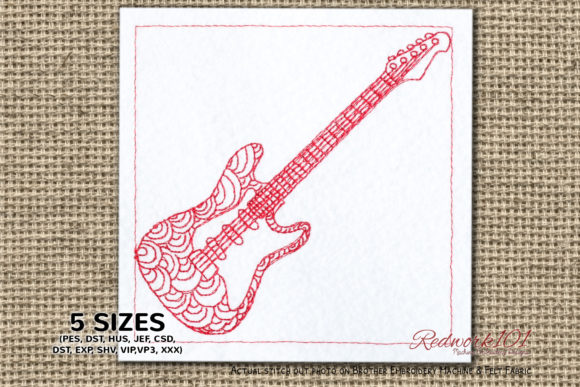
When I opened Electric-Guitar Redwork, my first thought wasn’t “cute” or “trendy”—it was “this will read clearly at 3 inches wide on a sweatshirt.” That’s the mark of a strong machine embroidery design: it lands with intention. The silhouette is unmistakably electric—sharp headstock angle, distinct body contour, recognizable pickup layout—yet simplified just enough to hold up in redwork’s classic single-outline style. There’s no fuss, no cluttered detail, and no visual competition between elements. It feels like a confident nod to music culture without leaning into cliché. As a designer who regularly sources embroidery files for client work and small-batch merchandise, I appreciate how this design avoids overcomplication while still carrying personality.
Where It Shines: Real Projects, Real Customers
Last week, I stitched Electric-Guitar Redwork onto a heavyweight cotton tote bag for a local record store’s staff gift set. The result? Immediate recognition, zero squinting, and genuine smiles from musicians and casual fans alike. That’s the sweet spot: it works equally well as a subtle accent on a baby onesie (paired with soft red thread on ivory jersey) or as a bold statement on a black hoodie for a band merch line. I’ve also used it successfully on tea towels—where its clean lines translate beautifully into kitchen-friendly charm—and as an embroidered patch on denim jackets, where the redwork aesthetic enhances the handmade product feel.
For Etsy sellers and craft fair vendors, Electric-Guitar Redwork fits naturally into themed collections: musician-themed baby gifts, graduation keepsakes for music majors, anniversary presents for guitar teachers, or even boutique-branded aprons for vinyl shops and coffee roasters with live music nights. Its Music category alignment isn’t forced—it’s functional. It doesn’t try to be everything; it does one thing very well, and that builds trust with buyers looking for authenticity over ornamentation.
What to Watch For: Fabric, Fit, and Finish
This isn’t a design that forgives poor execution. Because redwork relies on clear, unbroken outlines, stitch density and stabilizer choice matter more than usual. On thin or stretchy fabric—like lightweight tees or ribbed knit caps—I recommend testing with medium-weight cutaway stabilizer and reducing top tension slightly to prevent puckering. On dark fabric, standard red thread may lack contrast; switching to a burgundy or brick tone often reads richer and more professional in finished product photos.
The optional Box Stitch mentioned in the description adds structure but also weight. I’ve found it best suited for flat, stable surfaces—tote bags, pillow covers, or framed wall art—not curved areas like baseball caps or tightly seamed sleeves. If you’re planning holiday embroidery or personalized gifts with tight deadlines, skip the box on anything smaller than a 4×4 hoop. On baby embroidery or delicate items, omit it entirely unless you’re confident in your stabilizing technique.
Design Judgment: Clarity Over Complexity
One thing I consistently notice with Electric-Guitar Redwork is how well it scales. At 2.5 inches, it’s crisp on a child’s cap. At 5 inches, it commands attention on a blanket without bleeding or distortion. That scalability makes it unusually versatile for both personal projects and commercial embroidery. It doesn’t rely on tiny lettering, dense fill stitches, or fragile satin-stitch details—so it holds up through repeated washing, ironing, and daily use. That durability directly impacts customer trust: when a buyer sees a clean, consistent stitch-out on your Etsy listing, they imagine the same quality in their own hands.
For digital product sellers, this design performs strongly in printable mockups. Its high-contrast outline pops against light and dark backgrounds alike, making it easy to showcase across multiple product types without redesigning layouts. And because it’s rooted in redwork tradition—not trendy gradients or photorealism—it stays relevant across seasons and avoids dating your craft business inventory.
Practical Notes Every Embroidery Designer Should Keep Handy
- Always test on scrap fabric first—especially if using textured weaves like linen or terry cloth.
- Check thread color contrast before stitching on dark or heathered fabric; red thread isn’t always the strongest choice.
- Review stitch density visually in your embroidery software—if the lines look too thin or broken at actual size, adjust underlay or stitch width.
- Confirm hoop size compatibility before committing to a production run; some versions include the optional box in a larger format.
- Inspect small details like the bridge and tuning pegs—they should remain legible at your intended final size.
- Test in black and white mockups to ensure the design reads without color reliance.
- Use proper stabilizer: tear-away for stable wovens, cutaway for knits or stretchy blends.
- Verify licensing terms before selling finished items or bundling the embroidery file with other digital products.
Final Thought: A Reliable, Human-Centered Design Asset
Electric-Guitar Redwork won’t wow you with flash—but it will earn repeat use. It’s the kind of embroidery file I keep at the top of my folder for custom apparel requests, small shop branding, and last-minute personalized gifts that need to feel intentional, not generic. It respects the craft: no unnecessary complexity, no visual noise, just a solid, expressive shape that translates cleanly from screen to fabric. For makers who value clarity, consistency, and quiet confidence in their design assets, this is one redwork design worth keeping close.